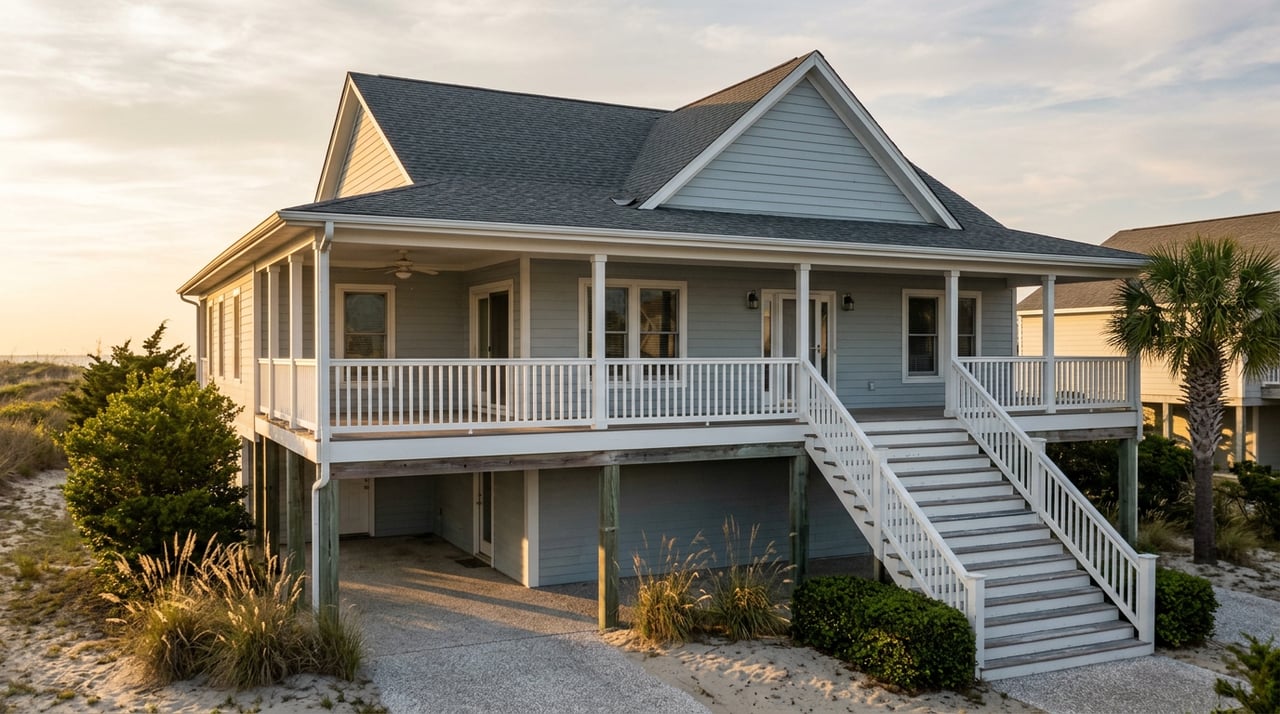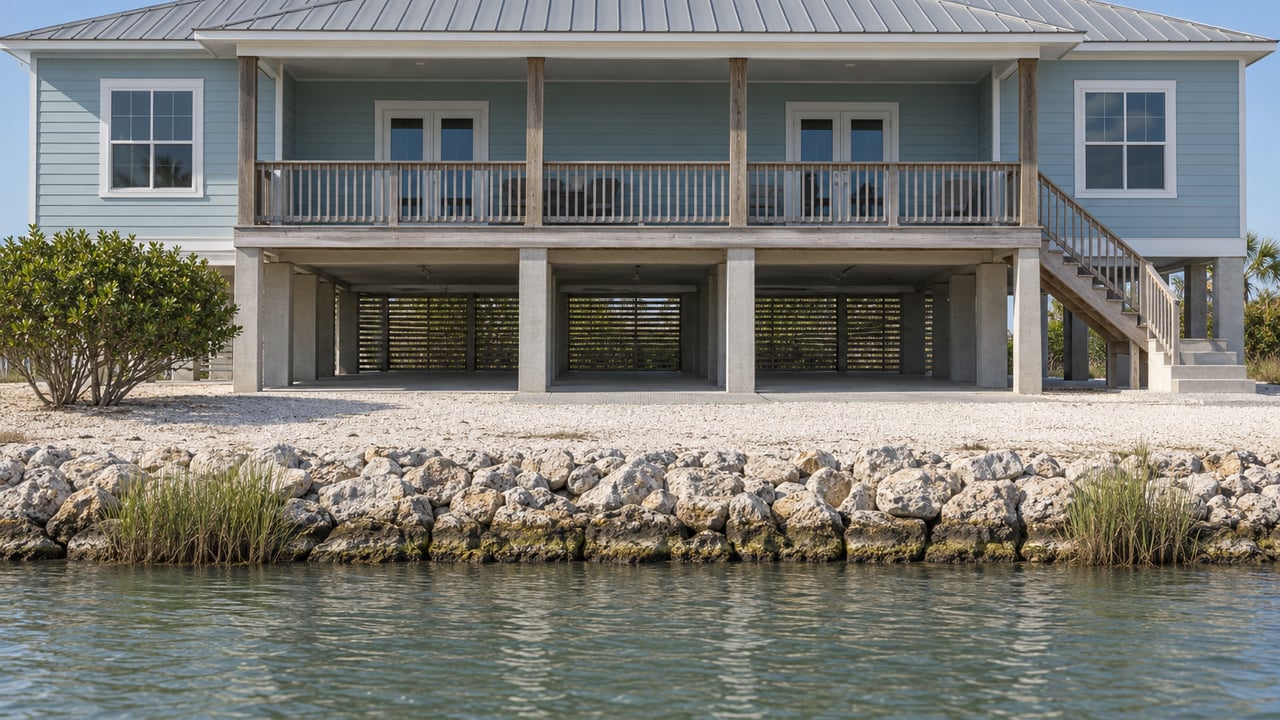
Tony Marino owns a canal lot on the east end of Sunset Beach with fifty feet of water frontage. When he and four neighbors sued the town over its dredging assessment in 2025, he made his case standing next to one of the town's own waterfront parks, which carries more than five hundred feet of frontage. Under the assessment the town had just approved, both parcels owed the identical amount: $7,710.31, billed once, payable in three installments. Marino's issue wasn't that the dredging shouldn't have happened. It was that a town park with ten times his frontage was "paying the same as my 50 feet."
That flat-fee math is still working its way through Sunset Beach's canal-front housing stock, and it matters to anyone buying, selling, or holding property on the water there. The assessment is real, it runs with the land, and a second, permanent version of it is currently being designed for the next dredging cycle.
What the Assessment Actually Paid For
Between 2021 and March 2024, the town carried out a mechanical dredging project covering South Jinks Creek, the Bay Area, the Feeder Channel, four Finger Canals on 6th Street, Marlin Street, Dolphin Street and Cobia Street, and Mary's and Turtle Creeks on the mainland side. It was funded mostly by a $5,235,134.18 state grant from the North Carolina Department of Environmental Quality's Shallow Draft Navigation Channel Dredging and Aquatic Weed Fund, with the town covering the remaining $2,475,010.97 in matching costs. Total project cost came in at $7,681,194.15, actually less than the $8,352,172.65 estimate the council had budgeted when it awarded the construction contract to R.E. Goodson Construction Company of Darlington, South Carolina.
The town recovered its share by billing the properties along the dredged waterways. According to the town's own assessment page, that works out to $7,710.31 per parcel, split into three installments: $2,594.35 due September 1, 2025, $2,750.01 due September 1, 2026, and a final $2,672.18 due September 1, 2027.
Read that schedule against today's date. The second installment came due three weeks ago. Any canal-front listing you're looking at right now either has that payment cleared or doesn't, and a title search alone won't always surface which.
The Method Behind the Number
The dollar figure is uniform because the town assesses by parcel, not by linear foot of water frontage. That wasn't the original plan. A 2002 dredging project in Sunset Beach had been assessed by frontage, and the council initially expected to do the same this time. In 2020 it changed course and voted 4-1 to charge every affected parcel the same flat amount regardless of how much canal frontage that parcel actually has.
The practical effect is what put Marino in court. A fifty-foot lot pays the same bill as the town-owned park frontage next to it. Joseph Cantoni, a Riverside Drive resident who later sued the town over the assessment, told reporters the comparable annual fee in Ocean Isle Beach and Holden Beach runs closer to $300 to $500 a year for a fifty-foot canal lot, a recurring charge rather than a single lump payment. Sunset Beach's approach is structurally different: one large bill, tied to project cost recovery rather than an ongoing maintenance fee.
Cantoni filed two lawsuits over the assessment. The first, in March 2025, was dismissed that April because the town hadn't yet formally approved the assessment roll, so the court found it had no live dispute to rule on. A second complaint, filed after the council approved the roll 3-1 on June 13, 2025, argued the town never properly established a fee-supported canal district before charging property owners under the state law that authorizes one. That suit was also dismissed, on procedural grounds, in August 2025. Neither ruling addressed whether the per-parcel method itself is fair. It simply means the assessment stands, and is being collected, while that underlying question has never been decided on the merits.
What to Check Before You Close
Because the assessment is a lien, not a bill that dies with the seller, it transfers with the property unless it's paid off or accounted for at closing. The town's own posted terms describe what that lien can do: it's enforceable the same way a property tax lien is, it sits behind tax liens but ahead of every other claim on the property, and the town has up to ten years from the first due date to begin foreclosure if a balance goes unpaid. The clock on that ten-year window started in September 2025, meaning enforcement stays live into 2035 for any parcel that falls behind.
As of the council's December 2025 update, payment on the 2024 project was still scattered. Eight property owners had paid the assessment in full. Five had made the first installment. Two had requested a waiver or acceleration adjustment but hadn't yet paid anything. Twenty owners hadn't made a payment at all. The council approved waiver and acceleration requests that month, including for owners who said they had not been properly notified.
For a canal-front purchase in Sunset Beach right now, that's a short, specific list to work through before you write an offer or sign a closing statement:
- Confirm with the town whether the assessment on the parcel is paid in full, current on installments, or in arrears
- Ask whether the property received a notification waiver or acceleration adjustment, since those change the payoff math
- Get the exact remaining balance and due dates in writing rather than relying on a general disclosure line
- Decide with your agent and closing attorney whether the seller pays off the balance, the buyer assumes remaining installments, or the amount gets prorated at closing
A Second, Larger Bill Is Still Being Drawn Up
The 2024 project addressed a backlog that had built up for years. It wasn't set up as a recurring maintenance program, and the council has been trying to build one since. In July 2025, it tried to pass a resolution creating a permanent, fee-supported Canal Dredging and Maintenance District under the same state law that lets Ocean Isle Beach run its own canal district. Residents pushed back hard enough at that meeting that the council tabled it, with speakers arguing the district boundaries weren't clearly drawn and that costs should be split by frontage rather than by parcel this time.
The council brought a revised version back in August 2025 and approved it. The town attorney was explicit that the resolution itself doesn't lock in a fee method. It authorizes the town to hire engineers who will study each canal, recommend whether the district should be one unit or several, and propose how the fee gets calculated. Council members said at the time that picking a firm and finishing that analysis probably wouldn't happen before the next town election, which means the actual fee structure will likely be a decision for a future council rather than the current one. In March 2026, the town issued a broader request for qualifications for on-call engineering services covering multiple departments, with submissions due April 1 and selection expected by late April. That keeps the town's engineering bench moving, but it isn't the same as a finished canal district fee schedule, which still hasn't been set.
Palm Cove, a small ten-lot gated community on the eastern end of the island, is a useful side note here. Its shoreline erosion problem along Jinks Creek is being handled separately, funded through a state grant paired with an HOA escrow arrangement rather than a town-wide assessment. A Palm Cove resident, Jill Runyon, told the council she saw no reason for her community to be pulled into the broader district discussion, since the completed dredging work stopped short of reaching her neighborhood in the first place. That's a reminder that not every canal-adjacent parcel in Sunset Beach sits under the same set of rules, and the boundaries of the new district haven't been finalized.
There's also a live question about whether the first project delivered what it promised. At an April 2026 council meeting, a resident named Gary Green described being told to expect a channel twenty feet wide and four feet deep, and said he's found stretches as narrow as six feet and as shallow as three. That's the same complaint canal-front owners raised back in 2025, that dredged material shifted rather than cleared, leaving some docks no better off than before the project started. It's relevant to anyone weighing the new district's fee, because it means the town is trying to design a permanent funding mechanism while still fielding complaints that the last funded project underdelivered.
Why the Bill Landed on the Canals Instead of the Beach
Sunset Beach's ocean-facing lots have largely avoided this kind of cost. The town sits next to Tubbs Inlet, the channel separating it from Ocean Isle Beach, which historically migrated west by fifty to sixty-five feet a year before it was intentionally closed in 1969 and redug about 3,200 feet to the east in 1970. That relocation has kept sand building up on Sunset Beach's oceanfront for decades, giving the town one of the wider natural beaches in the region without the repeated, expensive nourishment cycles that neighboring towns fund through their own tax structures. The interior canals don't get that same natural benefit. They silt in from stormwater runoff and tidal action, and clearing them takes exactly the kind of contested, capital-intensive project the town just went through. In Sunset Beach, in other words, it's the modest interior canal lot carrying the recurring cost risk, not the beachfront estate most buyers assume is the expensive one to hold.
If you're looking at a canal-front property in Sunset Beach and want the current assessment status pulled and explained before you make an offer, that's the kind of groundwork we do as a matter of course.
Steve Adams & Associates can run the payoff details for any specific parcel and walk you through what it means for your closing numbers.