On October 1, dwelling insurance for North Carolina's rental and vacation-home owners goes up by an average of 5 percent. That's the number circulating in owner group chats and property management newsletters right now. It's also the wrong number to budget from if the property in question sits on Oak Island, because the 5 percent is a blend, and the two ingredients in that blend are moving in opposite directions.
Here's the part the headline skips. The settlement that produced that 5 percent average splits a dwelling policy into two pieces. The fire portion of the rate is actually going down 5 percent for New Hanover, Brunswick, and Pender counties. The extended coverage portion, the piece that includes wind and hail, is going up 7.1 percent in those same counties. On an inland dwelling policy where fire coverage makes up most of the premium, that math nets out close to flat. On a barrier island where wind exposure drives the bulk of what an insurer charges, the math nets out closer to the higher number, not the average.
That distinction matters more here than almost anywhere else in Brunswick County, because Oak Island's housing stock is disproportionately non-owner-occupied. Weekly rental cottages, second homes, investment duplexes. Those are dwelling policies, not homeowners policies, and dwelling policies are the ones resetting on October 1.
Two Rate Cases, Two Different Bills
It's easy to conflate this with the homeowners insurance increase that made news across the Wilmington region last year, because both fights involved the same two parties: the North Carolina Rate Bureau, which represents the insurance companies, and Insurance Commissioner Mike Causey, who negotiates on behalf of policyholders. But they're separate cases, on separate timelines, covering separate properties.
| Policy | Covers | Rate Bureau's original ask | What was actually settled |
|---|---|---|---|
| Homeowners | Primary residences | 42.2% statewide average, up to 99.4% in beach territories | 7.5% effective June 1, 2025, plus 7.5% effective June 1, 2026 (16% then 15.9% in beach territories) |
| Dwelling | Non-owner-occupied homes, rentals, second homes | 68.3% over two years | 5% effective October 1, 2026, plus 5% effective October 1, 2027, statewide average |
Causey settled the homeowners case in January 2025, and at the time he said he'd "fought for consumers and knocked them back to 7.5% increases over two years with a maximum of 35% in any territory." That number, and the reporting around it, is what most Brunswick County residents remember. The dwelling case settled separately in April 2026, and it's the one that actually applies to the majority of Oak Island's transaction volume.
If you own the home you sleep in most nights, the June increases already hit your bill. If you own the cottage three streets from the beach that you rent out forty weeks a year, the October increase is the one you should be watching, and it's the one still landing on top of a premium base that's already climbed 25 to 40 percent since 2022 for a typical coastal North Carolina vacation home, according to industry cost tracking published this year.
The Stack, Not the Sticker
Dwelling insurance is also never the whole bill. Coastal owners here typically carry three separate policies. The dwelling policy covers fire and, depending on the carrier, some wind exposure through its extended coverage line. Wind and hail coverage often has to come from the North Carolina Insurance Underwriting Association, the market-of-last-resort pool that many coastal carriers lean on when they won't write full wind coverage themselves. Flood insurance is separate again, typically through the National Flood Insurance Program, priced under FEMA's Risk Rating 2.0 methodology, which rates each property individually rather than by flat zone.
Three bills, three renewal cycles, three sets of assumptions. A buyer running numbers on an Oak Island rental off a single insurance quote is running numbers on one-third of the actual cost structure. This is the friction that shows up during due diligence more often than any other line item on a coastal deal: the seller's current declarations page reflects last year's rate, the new buyer's quote reflects the October reset, and the two numbers don't match because they were never supposed to.
Where the Building Actually Helps
Oak Island's building code cuts against the rate increase in a few concrete ways, and this is where local construction detail earns its place in the conversation instead of being a footnote.
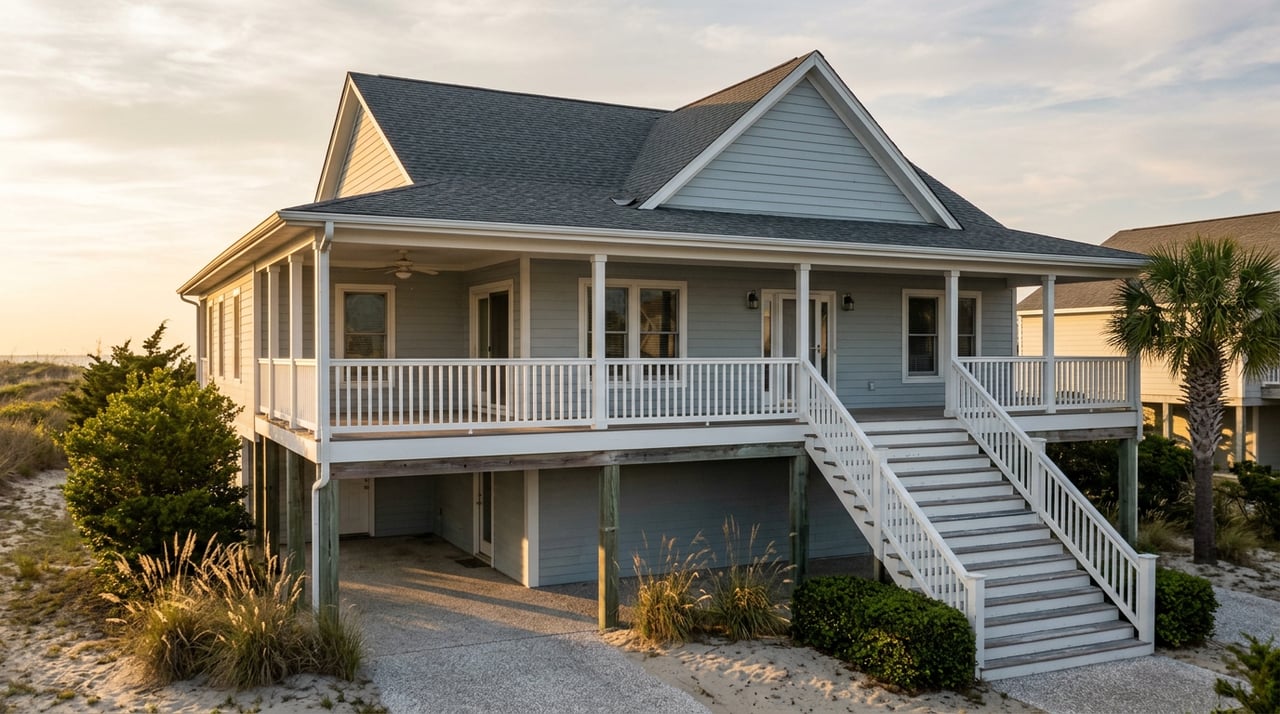
The town's zoning ordinance requires new construction in the floodplain to sit at least one foot above the base flood elevation, and everything built on the island has to meet 150 mph wind-zone standards. Homes on pilings tend to price better for flood coverage than slab-on-grade construction, because first-floor elevation relative to base flood elevation is one of the biggest inputs into a flood premium. Under Risk Rating 2.0, an elevation certificate isn't required to buy flood coverage, but submitting one can still lower the quote, and the Town of Oak Island keeps copies on file for most existing structures in the special flood hazard area.
The April settlement also increased the mitigation credit for FORTIFIED roofs, the wind-resistant roofing standard from the Insurance Institute for Business and Home Safety, by one to two percentage points across the board. That's a real number attached to a real study: a 2023 analysis from North Carolina State University's Institute for Advanced Analytics found fortified roofs cut reported claims by 34.5 percent and loss per building per storm by 22.7 percent. For a rental owner facing a 7.1 percent extended coverage increase, a fortified roof is one of the few levers that actually moves the number back down.
What the Beach Nourishment Project Does and Doesn't Fix
None of this happens in isolation from what's visible on the sand. Earlier this year, the town completed the largest non-emergency beach nourishment project it has undertaken in more than 25 years, a $33 million effort that brought over 1.6 million cubic yards of new sand to the shoreline. Crews working the joint Army Corps and offshore borrow operations reached the OKI Pier area in January 2026 as that work wound down for the season.
That project addresses erosion. It buys the town a longer stretch before the next renourishment cycle is needed, and it protects the upland infrastructure, roads, utilities, and homes, sitting behind the dune line. What it doesn't do is touch wind risk, which is a separate underwriting category entirely. An insurer pricing extended coverage on a rental home isn't modeling how wide the beach is. It's modeling roof age, wind-zone compliance, and storm history. A wider beach and a pricier wind policy can both be true on the same block at the same time, and they usually are.
What to Verify Before You Close on an Oak Island Rental
- Ask for current declarations pages on all three policies, dwelling, wind/hail, and flood, not just one combined number
- Request any elevation certificate on file with the Town of Oak Island's Development Services office, or budget for ordering a new one
- Confirm the roof's age and whether it carries FORTIFIED certification, since that credit just got larger
- Model the insurance stack as a percentage of projected gross rental income, not as a single year-over-year percentage change
- Check whether the property sits in an AE, VE, or X flood zone, since roughly 40 percent of NFIP claims nationally still come from lower-risk X zones where coverage isn't required but often still makes sense
FAQ
Does the October 1 increase apply to my primary residence on Oak Island? No. The October increase is for dwelling policies, which cover non-owner-occupied homes, rentals, and second homes that aren't your primary residence. Primary homeowners policies were already adjusted under the separate settlement that took effect in June 2025 and June 2026.
Will flood insurance costs change because of this settlement? Not directly. Flood insurance runs through the National Flood Insurance Program under its own Risk Rating 2.0 pricing, independent of the Rate Bureau's homeowners and dwelling settlements. Flood premiums move based on individual property risk factors, not this year's rate case.
Can I lower my dwelling insurance premium before the increase hits? The rate change itself applies at renewal regardless of timing, but the underlying inputs, roof condition, FORTIFIED certification, elevation documentation, are things you can act on before your policy renews. An updated elevation certificate or a fortified roof won't cancel the increase, but both can meaningfully offset it.
If you're weighing a rental purchase on Oak Island this fall, or trying to figure out what your current property's insurance stack actually means for next year's cash flow, Steve Adams & Associates works through these numbers with buyers and owners every week. Start with a conversation, or get your free home valuation, and we'll help you see the real cost picture before you commit to one.